
To say that it was transformative sounds cheesy and cliché, and I’m embarrassed to use these words. But really, I felt the kind of ease you get after being on a beach holiday for weeks (or, replace with whatever you find relaxing) in the space of just 2 days. Not only that, my brain felt like it was working better, in a more focused and perhaps creative way.
And that’s how this short teacher training started an intense obsession with all things yoga nidra, including reading and writing about the science behind it, and exploring ways to playfully introduce it to my yoga classes and beyond.
So what is yoga nidra?
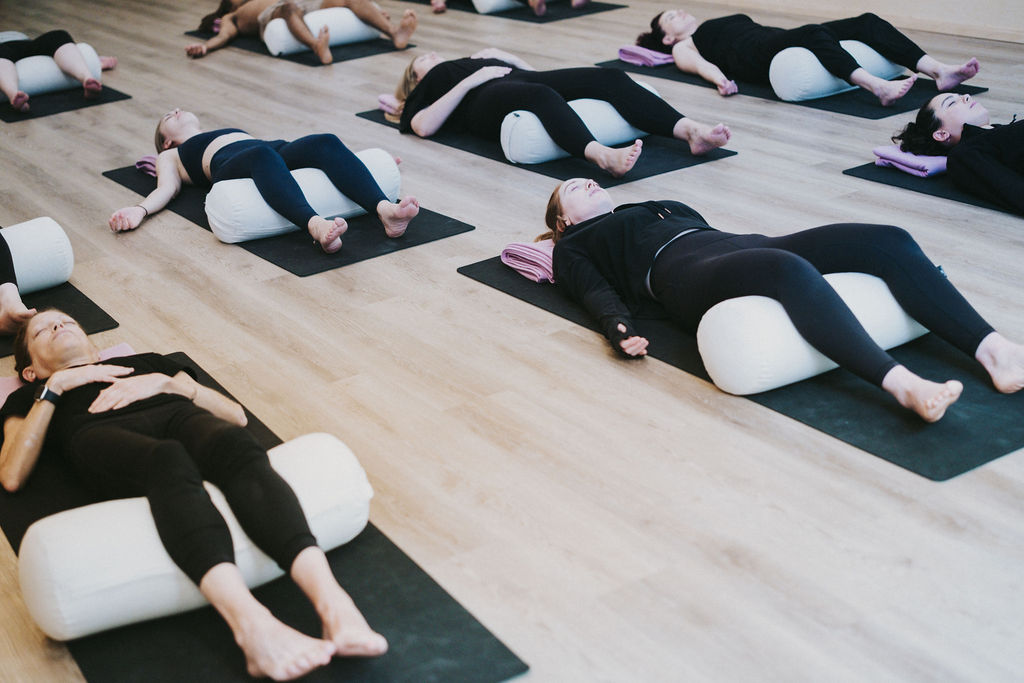
It is sometimes described as a state of awareness between sleep and wakefulness; or, my preferred description is the more poetic ‘liminal space’ between being asleep and awake. If you’ve ever practiced, this might be familiar – a feeling of drifting in and out of consciousness and remembering fragments of what the teacher said.
There are mentions of yoga nidra (the state of awareness) in ancient yogic texts, but the practice as we know it today is actually modern, devised in the 1970s by Swami Satyananda, inspired by Western psychology, hypnotherapy and yogic traditions. Since then, it has been shaped and adapted by many different teachers who have deviated from Satyananda’s original format. So, you might see it called other things too, like iRest (a practice designed by psychologist Richard Miller) and non-sleep deep rest, or NSDR (a practice popularised by Andrew Huberman, who claimed it isn’t yoga nidra, but really, it is).
A deeply relaxing practice that supports mental health
The ingredients of a yoga nidra practice vary depending on the teacher and the style they follow, but they tend to include some kind of body awareness or body scan, breath awareness, and usually some visualisations or other engagement of the senses. This combination may take our brain on a little journey too, switching us from a ‘doing’ and ‘self-control’ state (where the ‘executive network’ part of the brain is active) to one of simply ‘being’; a state of rest and feeling relaxed and possibly even a bit day-dreamy and more creatively engaged.
It is perhaps the brain state switch that contributes to the lingering feelings of ease. My own experiences of practicing mirror, excitingly, what research on yoga nidra has shown. Studies have found that practicing yoga nidra helped participants feel less stressed, more satisfied and positive about life and generally less negative than they did before they started the practice (and also compared with doing nothing at all, or what we call a ‘control group’). Moreover, recent evidence suggests that a regular yoga nidra practice may help to manage the levels of the stress hormone cortisol, providing direct evidence of stress management. It is likely this general switch towards relaxation that contributed to yoga nidra’s benefits on our sleep, which I’ve written about before.
There is also some evidence that a regular yoga nidra practice may help with anxiety and depression, at least in the groups of people it has been evaluated in (for example, older adults, university professors and students).
How to integrate this into your life
What the large research study teaches us is that you only need to take small steps to get the benefits of yoga nidra.
- Attend live classes. For me, there is something magical about attending a live yoga nidra session, almost as if psychologically the effects are amplified (a type of placebo effect). Look for classes that include yoga nidra at the end of the session. I teach yoga nidra as part of my yin yoga class, although it can be slotted into any class. Note that not all classes include yoga nidra in the class description, so you might just be pleasantly surprised!
- Practice at home. There are loads of pre-recorded practices on various apps and websites online (including my own on the app Insight Timer). Remember, you don’t have to practice for hours and hours; 10–15 minutes is still highly beneficial, but do practice regularly.
- Try practicing during the day. Most people use yoga nidra in the evening or to help them sleep. But you can practice yoga nidra at any time of the day and get a small boost of rest, which can help with focus and energy for the rest of your day. It might even help you sleep better later on. I like to practice (for just 10–15 minutes) in the afternoon, and especially when I feel tired, want to switch between very different tasks or if I want to move on to do something creative, like writing.
Ready to give yoga nidra a try?
Experience deep rest for yourself in a live class. Join our community today and get your first month for just £1 to try yoga nidra, yin and restorative classes across our London studios.

About Dr Rachel David
Rachel is a science geek, yoga teacher and writer, among other things. She fell in love with yoga after completing her PhD. Since then, she has lived up to her geeky persona by completing a number of trainings with amazing teachers. She teaches vinyasa flow, somatics-inspired flow, yin yoga and yoga nidra, weaving poetry (her other love) into her classes where possible.
An immunologist by training, she is a little bit obsessed by the science of mind–body practices like yoga, in particular the intersection of yoga with mental and immune health (called psychoneuroimmunology). She has written extensively about this and other topics on wellbeing, including sleep – subscribe to the mind–body adventure Substack (https://geekyyoga.substack.