
A guide to undoing what sitting does to your body, by personal trainer and MoreYoga instructor Eser Ozdag.
I got there through strength and mobility work, applied patiently and consistently. That is why I take sitting-related stiffness and back pain seriously in my clients, even when it looks minor on the surface. A tight hip or a weak glute might seem like nothing until it isn’t. I’ve lived on the far end of that spectrum, and I’d rather help people fix the small problems before they become the big ones.
That’s what this article is about.
Why sitting does this to you
Over time this shows up as stiffness, aches and fatigue, especially through the neck, shoulders, lower back and hips. None of this means your body can’t be fixed. It’s just adjusting to the lifestyle we have built.
The fix is not complicated. All it takes is a bit of dedication and consistency. A few assessments, paired with the right mix of mobility and strength work, can start undoing those patterns.
Mobility and strength
Strength is how much force your muscles can produce, and how well they can hold it.
If you only stretch, your muscles may feel relaxed for a short time, but they aren’t strong enough to support the joint. Your body doesn’t become stable. You may feel loose, but the problem comes back.
If you only do strength training and never work on mobility, your body gets stronger but stays stiff. It’s like building more muscle on top of a tight joint. That can reinforce a bad movement pattern and may cause pain or injury.
So the best approach is to train both together. Improve mobility so the joint can move well, and build strength so the body can control and support that movement.
Desk workers need both, in the same routine:
- Restoring mobility where you’ve gone tight
- Strengthening what sitting has switched off
- Building better posture and movement habits through the day
What sitting actually does to your body
Tight hip flexors and psoas. Sitting keeps your hips in constant flexion, so the hip flexors and psoas shorten over time. A tight psoas tilts the lower back and causes that pain you feel when you finally stand up.
Weak glutes and hamstrings. In a seated position these muscles are lengthened but switched off, inactive and doing almost nothing. Understimulated for hours and days at a time, the lower back ends up picking up the slack and taking all the pressure. The lower back isn’t built for that, but with the glutes not firing, the body naturally leans on it.
Forward head posture and neck tension. Hours staring at a screen pull the head forward, loading the neck and upper back far more than they’re designed for. The head weighs roughly 10-12 lb, and the further it moves forward, the greater the mechanical load on your neck. The result is neck stiffness, upper back tension, a tight chest, and deep neck stabilisers that aren’t doing their job.
Stiff ankles and restricted shoulders. Both joints need regular movement. If the ankle is stiff, the knee can’t travel forward during a squat and the pressure goes into the hips, back and quads. Stiff shoulders make reaching and lifting harder than it should be. Shoulder joints should move freely in many directions, but after too long sitting, arms won’t lift as high or reach as far, and the body relies on the neck and upper back instead.
Three quick checks you can do at home
Ankle mobility wall test. Stand facing a wall, place one foot about 4-5 inches back from it, keep the heel down and try to touch your knee to the wall. Repeat on the other side. If one side is noticeably stiffer, or your heel lifts, your ankle mobility needs attention.
Shoulder mobility check. Reach one arm over your shoulder and down your back, and the other arm behind your lower back and up, trying to touch or nearly touch your fingers. Compare sides. A big difference usually points to shoulder or upper back restriction.
Hip flexor and psoas check. Get into a half-kneeling position, squeeze the glute on your back leg, and shift your hips gently forward without letting your lower back arch. Pay attention to the front of your hip and thigh. Significant tightness, or pinching in the lower back, suggests your hip flexors are limiting you.
The areas worth mobilising
Psoas and hip flexors: half-kneeling hip flexor stretch
Don’t allow your lower back to arch. Arching takes the stretch away from the psoas and puts pressure on your lower spine instead.
Ankles: knee to wall rocks
Shoulders and upper back: wall slides
This builds shoulder mobility and strengthens the upper back at the same time.
The areas worth strengthening
Hamstrings: glute bridge
Glutes: single-leg bridge
Your glutes are the power house of the body. When they’re weak, your lower back and hamstrings take over the job.
Core: dead bug
This exercise isn’t about developing abs. It’s about teaching your spine and pelvis to stay stable while your limbs move.
Why your neck is always tight
Chin tuck. Sit or stand tall and gently glide your head straight back, as if making a double chin. Keep your eyes level, hold for 2-3 seconds, and repeat 10 times. This wakes up the deep neck stabilisers and takes the load off the back of your neck.
Foam roller thoracic extension. Place a foam roller under your upper back with your hands supporting your head, and slowly move up and down the upper back. This helps restore upper back mobility and reduces the strain on your neck.
A daily desk reset, in 15 to 20 minutes
- Ankle rocks, 8-10 per side
- Half-kneeling psoas stretch, 30-60 seconds per side
- Wall slides, 8-10 reps
- Glute bridge, 12-15 reps, 2-3 sets
- Dead bug, 6-8 per side, 2-3 sets
- Chin tuck, 10 reps, 2-3 sets
Do this three to five times a week, or daily if it feels good.
Lifestyle habits that matter just as much
- Move every 30-45 minutes, even if it’s just for a minute or two
- Set your monitor at eye level
- Keep your feet flat on the floor
- Use a standing desk, or take a walking meeting when you can
- Build in movement snacks through the day
- Avoid staying fixed in one position for hours at a stretch
The goal isn’t to avoid sitting altogether. It’s to interrupt long stretches of it and give your body the movement it’s asking for.
Final thoughts
I learned it because I needed it. At one time my only goal was to walk without pain. Money and every other goal stopped mattering until I could move without pain again. As they say, health is your greatest wealth. Strength and mobility work gave me back my body, and now I try to give the same thing to my clients.
You don’t need many hours of training. You need three things:
- Do a little, often. Consistency is the key.
- Feel your body and notice what is tight or weak. That’s awareness.
- Do the right exercises for the body you have now.
Mobility and strength are not enemies. They work together. When you have both, you move better, sit more comfortably and feel stronger in daily life. Strength without mobility, and mobility without strength, are incomplete.
The Desk Body Reset: Mobility Workshop for Tight Hips and Neck and Back Pain
MoreYoga Canary Wharf
Sunday 4 October 2026
2:00pm to 4:00pm, 120 minutes
With Eser O.
Limited spaces
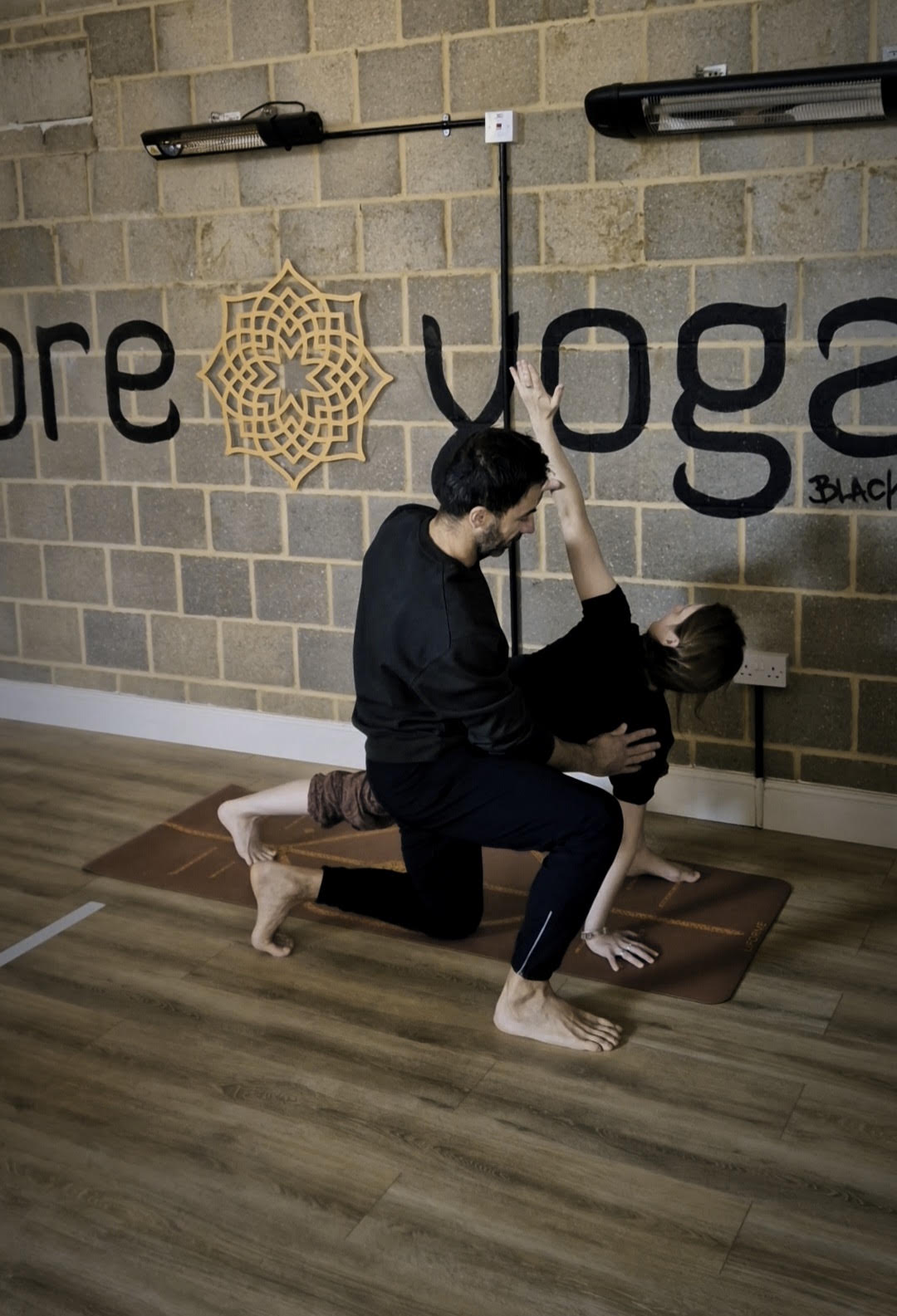
About Eser Ozdag
For coaching enquiries:
Email: eserozdag@googlemail.com
Web: precisionbyeser.com
Instagram: @precision_by_eser